The Cost That Comes Every Month for the Life of the System
Water softener salt is the one consumable in a system that otherwise runs for 15 to 20 years without significant repair expense. The control valve, the resin tank, the brine tank, and the bypass valve are all purchased once and maintained rather than replaced on a schedule. The salt has no such permanence. It goes in every month, it comes out as part of the regeneration process, and it has to be replenished regardless of how well everything else is functioning.
What most buyers do not calculate until they are a year into ownership is that the annual salt bill for a household of four runs $100 to $200 at current prices. That is not a burden, but it compounds: use the wrong type and you are also paying in extra maintenance time. Use more than you need to and you are spending 30 to 50 percent more per year than the system actually requires. The broader context on what installation and long-term upkeep actually involve is in our broader breakdown of water softener installation and maintenance, but salt is the variable that starts running the day the system goes live.
Three decisions determine what salt costs you over time: which type goes in the brine tank, how much is normal at your water hardness and household size, and where to buy. Each of those has its own dedicated article with full detail linked at the bottom of this page. The overview below is enough to make a practical decision before the first bag goes in.
- Most homes on city water: high-purity evaporated pellets are the safest default choice
- Humid garage or basement install: pellets specifically, not crystals, which mush faster under humidity
- Well water with low iron (under 1 PPM): iron-fighter pellets can help maintain resin between cleanings, but are not a substitute for a sediment pre-filter
- Cabinet-style softener: block salt as specified by the manufacturer, not pellets or crystals
- Physician-ordered sodium restriction or California discharge regulation: potassium chloride, priced at roughly three to four times sodium pellets
- Cannot easily transport 40 lb bags: a delivery subscription at home improvement store pricing or better is often the better total value once logistics are factored in
Pellets, Crystals, or Blocks: Which Type Goes in Your Brine Tank
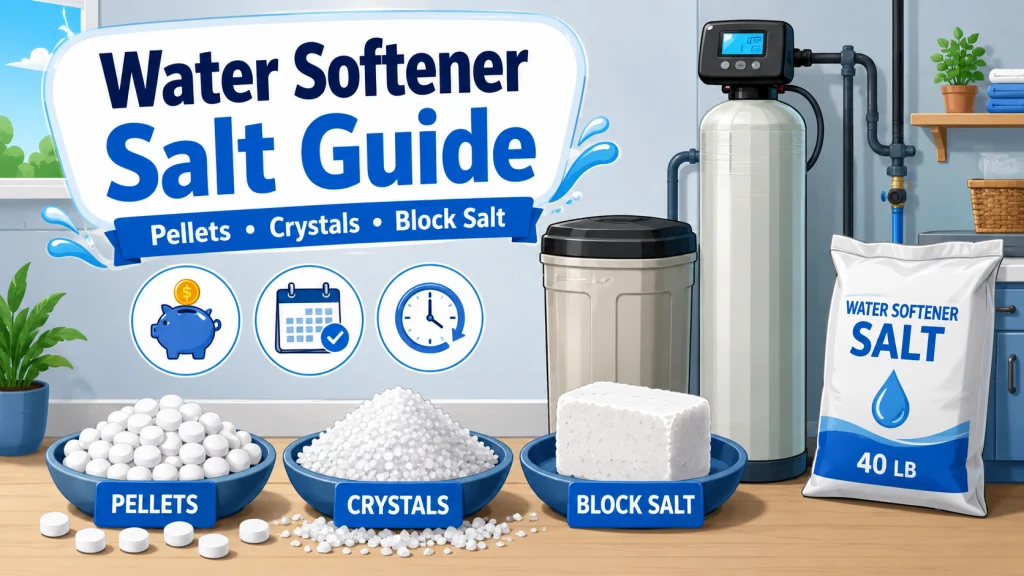
There are three forms of water softener salt sold at most hardware and big-box stores. They are not interchangeable, and the differences are not just about purity. They are about how the salt behaves inside the brine tank over weeks of use.
Pellets are the standard recommendation for most residential systems. They are compressed sodium chloride with high purity, typically 99.5 to 99.8 percent, and they are specifically engineered to resist two of the most common brine tank problems: bridging, where a hard crust forms above the water level, and mushing, where dissolved salt recrystallizes into thick sludge at the bottom. The compressed form holds together under humidity and temperature swings in a way that loose crystals do not. For most homes on city or well water with a standard two-tank softener, pellets are the right default without much further analysis.
Crystals work, but they come with a documented trade-off. The granular structure dissolves faster and less evenly, and in high-humidity environments like a basement with moisture issues or a garage with temperature swings, they are more prone to mushing than pellets. I’ve seen enough sludge-clogged brine tanks to recognize crystals as the common thread when the homeowner swears nothing changed. If pellets are available at a comparable price, there is no practical reason to reach for crystals instead.
Block salt is the one that causes the most confusion at the store. It is designed specifically for cabinet-style softeners, where the block sits in a dedicated compartment with a controlled water level. In a standard two-tank residential softener with a separate brine tank, block salt does not work the way it looks like it should, and can clog the brine line. If your system does not specifically call for block salt, skip it regardless of where it is stocked on the shelf.
| Salt Type | Best For | Main Trade-off |
|---|---|---|
| Pellets (evaporated) | Most residential softeners, city and well water | Slightly higher cost than solar crystals |
| Solar crystals | Low-humidity environments, lower-use households | More prone to mushing and bridging under humidity |
| Rock salt | Not recommended for residential use | Lower purity, accumulates sludge faster in brine tank |
| Block salt | Cabinet-style softeners only | Cannot substitute for pellets in two-tank systems |
A pattern I see repeat: homeowners switch from pellets to crystals to save a dollar or two per bag, then call six months later wondering about a mushing problem. The connection between the change and the symptom is not always obvious when the problem surfaces slowly. The full type comparison, including when iron-fighter formulations belong in the rotation, is in the water softener salt types guide.

Refined to up to 99.8% purity and virtually 100% water soluble, these premium salt pellets deliver consistent softening performance while helping extend the life of your appliances, pipes, and fixtures. Soft water also keeps laundry brighter and hair noticeably softer with regular use.
Check On AmazonIf you click this link and buy, we earn a commission at no additional cost to you.
How Much Salt Is Normal, and When the Number Is Too High
One 40 lb bag per month is the standard benchmark for a household of four with water at 7 to 12 GPG using a demand-initiated (metered) softener. That puts annual cost at 10 to 12 bags, or roughly $80 to $120 at warehouse prices. If you are going through a bag every two to three weeks at that household size and hardness level, something is misconfigured. Finding the cause before that pattern continues for another year is worth 15 minutes.
The two variables with the biggest impact are actual water hardness and regeneration type. A household at 20 GPG uses roughly twice the salt of a household at 10 GPG with the same number of people and the same system. Timer-based softeners, which regenerate on a fixed schedule regardless of actual water use, are the other major factor. A timer set to cycle every three days burns through salt whether the household used 200 gallons that cycle or 50. Switching from a timer-based to a demand-initiated system can cut salt consumption by 30 to 50 percent in many homes, with no change to softening performance.
Field Note: One of the most consistent patterns I run into is homeowners who set the hardness level on the control head higher than their actual water test result, on the logic that a little extra margin is safer. A home with 22 GPG water and a control head programmed to 35 GPG is triggering regeneration cycles far more aggressively than the resin actually needs. The system is working exactly as instructed. It is just instructed wrong. I’ve seen monthly salt use drop by nearly half after correcting the setting to match the water test. The fix takes two minutes: test the water, read the result, enter the number.
| Household Size | Water Hardness (GPG) | Estimated Monthly Salt (demand-initiated regen) |
|---|---|---|
| 1 to 2 people | 7 to 10 GPG | 0.5 bag (approx. 20 lb) |
| 2 to 4 people | 7 to 12 GPG | 1 bag (40 lb) |
| 2 to 4 people | 15 to 20 GPG | 1.5 to 2 bags (60 to 80 lb) |
| 4 to 6 people | 10 to 15 GPG | 1.5 to 2 bags (60 to 80 lb) |
| 4 to 6 people | 20 GPG or above | 2 to 3 bags (80 to 120 lb) |
These estimates assume the hardness setting matches your actual water test result and that the system regenerates on demand rather than a fixed timer. Timer-based systems can run 50 percent or more above these numbers without any malfunction. If your usage runs well above the table estimates and the hardness setting is confirmed correct, check how frequently the system is actually regenerating. The full breakdown on what drives salt consumption, including how to calculate expected monthly usage for your specific home, is in the salt usage and consumption guide.

This kit includes 150 dip-and-read test strips for quickly measuring water hardness across virtually any source, including home faucets, well water, softeners, dishwashers, showers, and aquariums. Results are instant and easy to read against a color chart, making it simple to verify whether your water softener, reverse osmosis, or water conditioning system is performing as expected. A bonus eBook is included to help you record, track, and interpret your results over time.
Check On AmazonIf you click this link and buy, we earn a commission at no additional cost to you.
Iron Fighter Salt: What It Does and Where It Falls Short
Iron-specific salt formulations contain additives, typically citric acid or a similar compound, designed to help loosen iron deposits from resin beads during each regeneration cycle. The logic is sound. Iron from well water coats resin over time, reducing softening capacity, and running a cleaning agent through the system at each regen slows that process. For low iron levels in the 0.3 to 1 PPM range, iron-additive salt provides real, if limited, maintenance value.
At 2 PPM and above, the additive is not enough on its own. At that concentration, iron is coating the resin faster than the additive can clean it at normal cycle intervals. What you need at that level is a dedicated iron filter installed upstream of the softener, or a system rated for combined iron and hardness removal. Using iron-additive salt above 2 PPM iron does not solve the fouling problem. It slows the rate at which the problem develops, which is a different thing.
A direct resin cleaner used every three to six months often does more work than iron-additive salt alone. The cleaner goes into the brine tank at a higher concentration and clears fouling more aggressively than a regeneration additive can during a normal cycle. Some well water systems use both: iron-additive salt for routine cycles and a direct resin cleaner a few times per year for deeper cleaning. Neither approach replaces a sediment pre-filter for well water with significant iron or sediment content. The pre-filter is what stops iron from reaching the resin in the first place, which is always the more cost-effective fix when it is applicable.

This professional-grade liquid cleanser removes iron, manganese, silt, metal particles, and other contaminants that salt leaves behind in your resin bed, valve parts, and beads. Regular use helps extend appliance life, reduce maintenance calls, and maintain consistent water quality across any water softener brand. It is NSF certified to NSF/ANSI/CAN Standard 60 for drinking water additives and is made in the USA, making it safe for families and pets. Apply 4 oz before each regeneration or use with the Pro Products Easy Feeder kit for daily low-dose treatment.
Check On AmazonIf you click this link and buy, we earn a commission at no additional cost to you.
Potassium Chloride: When the Higher Price Is the Right Call
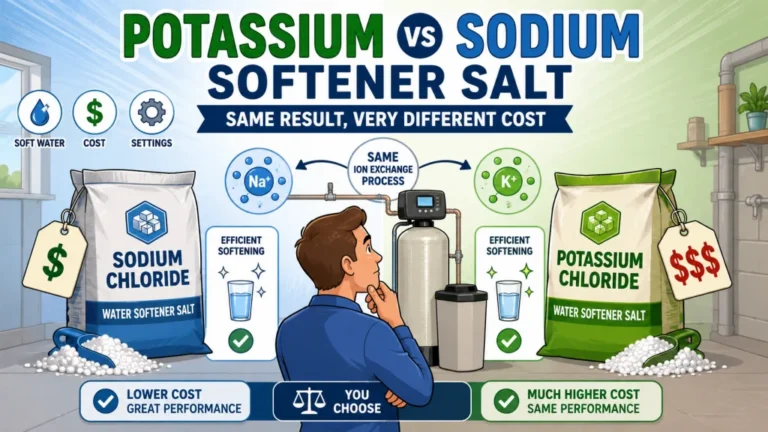
Potassium chloride runs the same ion exchange process as sodium chloride. Instead of adding trace sodium to the treated water, it adds trace potassium. The softening result is the same. The cost is not: a 40 lb bag of potassium chloride typically runs $25 to $35, compared to $8 to $10 for high-purity sodium pellets. That is three to four times the ongoing cost for an equivalent outcome in most situations.
The cases where potassium chloride makes practical sense are genuinely narrow. A physician-ordered severe sodium restriction is the clearest one, where even the trace sodium added to softened water is clinically relevant. Some California water districts restrict sodium chloride discharge from softener regeneration, making potassium chloride the required alternative in those areas. Outside those two scenarios, the trace sodium that a properly functioning softener adds to drinking water is well below the levels most low-sodium diets are actually tracking.
One adjustment is required if you switch: set the hardness level on the control head roughly 20 to 25 percent higher than your actual GPG reading. Potassium chloride is less efficient at regenerating resin than sodium chloride, and keeping the same hardness setting will result in the softener underperforming. The full cost comparison and the settings adjustment explained in practical terms is in the potassium vs sodium water softener salt guide.
Where to Buy Salt and What to Expect to Pay
The price spread between retailers is not dramatic on any single bag, but it accumulates across years of monthly purchases. Warehouse club stores like Costco and Sam’s Club typically carry 40 lb bags in the $8 to $10 range. Hardware and home improvement stores like Home Depot and Lowe’s generally run $10 to $12. Online subscriptions through Amazon vary by zip code, but can be competitive once delivery cost is factored in rather than ignored.
At the high-purity pellet tier, the formula is largely the same product across retail brands. A 40 lb bag of 99.6 percent pure pellets from one major manufacturer performs about the same as a comparable product at a slightly different price on the same shelf. The meaningful quality distinction in salt is between high-purity pellets and rock salt or low-purity options, not between competing pellet brands at similar purity levels.
One consideration most price comparisons skip is the physical logistics. Carrying 40 lb bags from a warehouse store requires vehicle space and the physical effort of loading, transporting, and stacking. For households where that is not straightforward, a delivery subscription at a price comparable to a home improvement store is often the better total value once time and effort are in the calculation. It is not a question most buyers think to ask until the third or fourth time they are lifting bags into a car with limited trunk space.
- Warehouse club stores (Costco, Sam’s Club): typically $8 to $10 per 40 lb bag, best regular per-bag price for members who can transport
- Hardware and home improvement stores (Home Depot, Lowe’s): typically $10 to $12 per 40 lb bag, widely available without membership and convenient for most schedules
- Online subscription (Amazon and others): price varies by zip code, competitive when delivery replaces a dedicated trip, and eliminates heavy lifting entirely
- Local water treatment dealer: typically the highest per-bag price, reasonable if you are already scheduling a service visit but not the best ongoing option for salt alone
The detailed price comparison by retailer, including current per-bag figures and the case for each buying option depending on household situation, is in the guide on where to buy water softener salt.

These 99% sodium-free pellets offer a healthier alternative to traditional salt for anyone monitoring sodium intake while still enjoying the benefits of softened water. The bag features a sturdy plastic handle for comfortable carrying and an easy-tear opening for hassle-free pouring.
Check On AmazonIf you click this link and buy, we earn a commission at no additional cost to you.
Final Thoughts: Three Decisions That Determine Your Salt Cost for the Life of the System
The three decisions that determine your long-term salt cost are simpler than most owners expect. Choose high-purity pellets as the default unless your system specifically requires something else. Set the hardness control to your actual water test result, not an estimate rounded up for safety margin, because overestimating is the most common reason households burn through salt faster than they need to. And buy from a source that suits your household logistics, not just the closest one.
Those three choices account for most of the difference between households spending $100 per year on salt and those spending $300 for the same softening outcome. Salt is the one variable in a softener system that compounds in both directions: get it right and it runs in the background without much thought; get it wrong and it quietly costs you in money and maintenance time for years.
More on Water Softener Salt
Each article below covers one salt question at a depth that a hub overview cannot. If you already know which question applies to your situation, go directly to the relevant one rather than reading through all of them.
| Article | What It Covers |
|---|---|
| Water Softener Salt Types | Full type comparison with purity data, including why block salt fails in standard brine tanks and when iron-fighter formulations are actually useful. |
| Best Water Softener Salt: Recommendations From a Former Installer | Specific product picks from hands-on experience, with a short list covering most situations and guidance on when to deviate from the default. |
| Potassium Chloride vs Sodium Chloride for Water Softeners | When paying three to four times more for potassium chloride is the right decision, with cost math and the control head adjustment required when switching. |
| How Much Salt Does a Water Softener Use? | Normal usage by household size and GPG with calculation guidance, plus the hardness setting error that is the most common cause of excess salt consumption. |
| Water Softener Salt Bridge and Salt Mushing | Two problems that look similar from the outside but require different fixes, with a step-by-step diagnostic to identify which one you are dealing with. |
| Where to Buy Water Softener Salt | Retailer price comparison with current per-bag figures, and when a delivery subscription is the better total value over hauling bags yourself. |
Start with whichever question is most immediate. The others will come up at some point over the life of the system.
FAQs
🧂 Can I mix pellets and crystals in the same brine tank?
You can without damaging anything. The concern is that crystals mush more easily than pellets, so a tank with a significant share of crystals will trend toward mushing faster, especially in humid environments. If you have leftover crystals to use up, top off with pellets going forward and you’ll gradually shift the balance in the right direction.
⏱️ How often should I check the salt level in my water softener?
Every four to six weeks is the right baseline for most households. For a family of four at moderate hardness, that interval also roughly coincides with when you’ll need to add a bag. Check more frequently if you’ve had a salt bridge recently, since bridges can reform when the underlying cause, typically overfilling or crystal salt, hasn’t been addressed.
🏗️ What causes a salt bridge and how do I fix it?
A salt bridge is a hard crust that forms above the water line in the brine tank, leaving a hollow space below where salt should be dissolving into brine. High humidity, overfilling the tank, and lower-purity crystal salt all increase the likelihood. To fix it, press firmly down through the salt with a broom handle until the crust breaks apart. Do not use anything sharp that could puncture the brine tank wall.
🪣 How full should I keep the brine tank?
Between one-third and two-thirds full is the practical target. Filling to the top packs the salt too tightly and raises the likelihood of bridging. Running the tank below six inches above the water level risks running dry between refills. Halfway is a reasonable default if you are checking every four to six weeks.
🏙️ Is iron fighter salt worth using if I have city water?
In most cases, no. Iron-fighter formulations are designed to clean iron deposits off resin beads, and iron in resin comes from well water, not treated municipal water. Most treated municipal water has little to no iron by the time it reaches your home. For city water installs, a standard high-purity pellet is all the system needs, and iron-fighter salt does not add meaningful benefit.
🔬 Does more expensive salt actually perform better?
At the high-purity pellet tier (99 percent and above), the performance difference between brands is minimal. What you are mostly paying for above that threshold is brand recognition and packaging. The meaningful upgrade is from rock salt or low-purity crystals to high-quality pellets. Beyond that quality level, competing pellet products perform comparably at the residential softener scale.