Several Options in the Aisle, One Right Answer for Most Setups
Standing in the water treatment aisle at a hardware store, you will usually find at least three different bags of salt with different labels and marginally different prices. Nothing on the bag tells you which one matches your softener. Nothing on your softener tells you which one to buy. The result is that most people either grab whatever is cheapest or default to whatever they bought last time without thinking about it.
The differences between salt types are real and they matter, though not always in the way you might expect. The chemistry of sodium chloride is not what varies. What varies is the physical form of the salt, the purity level, and how each type behaves once it is sitting in your brine tank for weeks at a time. That behavior is what drives maintenance differences. If you are still working through how salt fits into the broader system, including usage rates and where to find the best price per bag, the water softener salt guide covers the full picture. For the type comparison, keep reading.
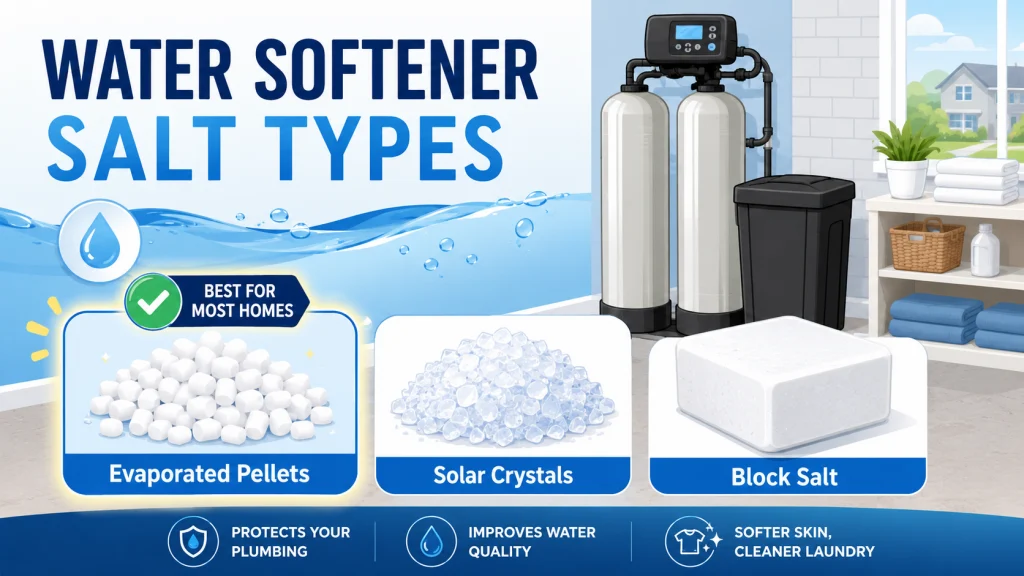
The short version: if you have a standard two-tank softener, evaporated pellets are the answer. Everything else has a narrower use case. The longer version follows.
Evaporated Pellets: The Default for Good Reason
Evaporated pellets are manufactured by heating brine solution until the water evaporates, then compressing the remaining sodium chloride into uniform oval shapes. That compression is the key. Pellets are denser than crystals, which makes them significantly more resistant to mushing. Purity typically runs 99.6% to 99.8% sodium chloride, meaning very little insoluble residue accumulates at the bottom of the brine tank over time.
I recommend pellets to almost every homeowner regardless of water hardness or household size. The maintenance case is straightforward: less mushing means less cleanup, and less insoluble residue means the brine tank stays cleaner longer. Those two things translate to real time saved over years of ownership.
Field Note: One pattern I run into with regularity is homeowners who switched to crystals or rock salt to save a dollar or two per bag and ended up spending an afternoon cleaning compacted sludge out of the brine tank a year later. The price difference at most hardware stores is two or three dollars per 40-pound bag. When you factor in a brine tank cleaning, which involves scooping out wet, compacted salt with a scoop and a shop vac, the savings evaporate quickly. Pellets cost slightly more per bag and require less maintenance work. The math is not close.
One detail worth checking on the bag: the purity percentage. Reputable pellet products show 99.6% or higher on the label. Below 99%, the remaining percentage is mineral impurities that do not dissolve and settle at the bottom of the brine tank. That is not an immediate problem, but it accumulates. Higher purity means less to clean out over time.

Refined to 99.8% purity, these pellets minimize tank residue and are specifically formulated to resist clumping and salt bridges that can cause system malfunctions. By removing hard minerals like calcium and magnesium, they help extend the life of your dishwasher, washing machine, and water heater while preventing scale buildup in pipes. Compatible with all major water softening systems, the 50-pound bag features a patented dual-handle design for easier and safer lifting and pouring.
Check On AmazonIf you click this link and buy, we earn a commission at no additional cost to you.
Solar Crystals: Fine in the Right Conditions
Solar crystals are produced by evaporating seawater or natural brine in large open ponds, then harvesting and drying the resulting salt. They are not compressed like pellets, which gives them an irregular, coarser texture. Purity is typically comparable, often 99.5% to 99.6%. On paper, crystals and pellets look similar. The difference shows up in the brine tank.
Because crystals are not compressed into a dense form, they are more vulnerable to humidity and temperature swings. In a warm garage in summer, or a basement with any meaningful moisture in the air, crystals absorb humidity and compact together into a wet mass rather than dissolving cleanly. That process is called mushing, and it is more common with crystals than with pellets under the same conditions. In a temperature-stable indoor utility room with controlled humidity, crystals perform reasonably well and many homeowners use them without issue. The problem is that not every installation is that clean.
What Mushing Does to Your System
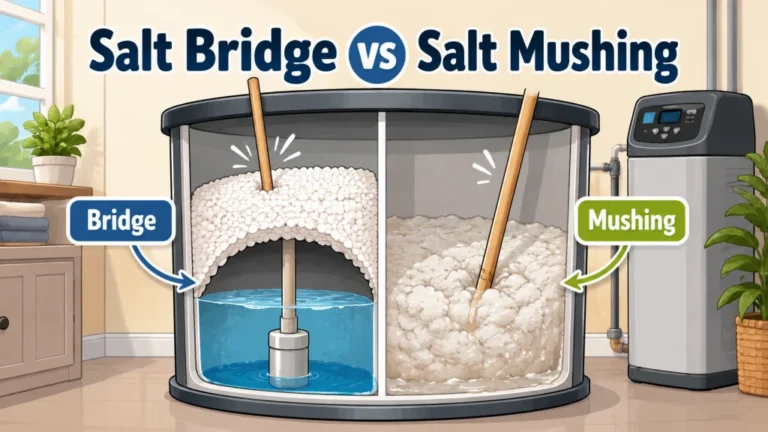
Mushing is not a dramatic failure. It is a slow decline. When salt at the bottom of the brine tank compacts into a wet sludge instead of dissolving into the water, the brine solution that forms is weaker than it should be. Weak brine means incomplete resin regeneration. Incomplete regeneration means the resin beads do not fully recharge, and over time, hard water starts returning before the next regeneration cycle is scheduled. If you are seeing scale coming back on fixtures a year or two after installation and you have not touched the system settings, mushing is worth checking before anything else.
When the salt level in the brine tank gets low enough to see the bottom, look for a thick compacted layer rather than loose granules. That layer needs to be manually removed before you refill.
Salt Bridging: The Other Way Crystals Cause Problems
Salt bridging is a different failure mode that often gets confused with mushing. A salt bridge forms when a hard crust of salt develops partway up the brine tank, spanning across the walls and leaving an empty or water-only space underneath. The salt level on top looks fine, sometimes even full, but no salt is actually reaching the water below to form brine. The system runs regeneration cycles on plain water, the resin never recharges, and the homeowner wonders why the water is getting hard again despite a brine tank that appears to have plenty of salt.
The fix is simple once you know what to look for: push a broomstick or a long rod down through the salt. If it breaks through a hard crust and drops several inches unexpectedly, you have a salt bridge, not a full tank. Break it up, let the pieces dissolve over a few days, and check that the system regenerates normally before refilling completely. Crystals are more prone to bridging than pellets in humid environments because the irregular shape of crystal particles fuses together more easily when moisture is present. Pellets resist this for the same reason they resist mushing: the compressed, uniform shape leaves less surface area for particles to bond to each other. The salt bridge and mushing guide covers both problems in detail, including how to confirm which one you are dealing with when the symptoms overlap.

This professional-grade liquid cleanser removes iron, manganese, silt, metal particles, and other contaminants that salt leaves behind in your resin bed, valve parts, and beads. Regular use helps extend appliance life, reduce maintenance calls, and maintain consistent water quality across any water softener brand. It is NSF certified to NSF/ANSI/CAN Standard 60 for drinking water additives and is made in the USA, making it safe for families and pets. Apply 4 oz before each regeneration or use with the Pro Products Easy Feeder kit for daily low-dose treatment.
Check On AmazonIf you click this link and buy, we earn a commission at no additional cost to you.
Rock Salt and Block Salt: Narrow Use Cases, Real Consequences If You Get It Wrong
Rock salt is mined directly from salt deposits and sold with minimal processing. Purity runs lower than pellets or crystals, typically 98% to 99%. That extra 1% to 2% of impurities might sound minor, but in a brine tank that cycles water through the same space repeatedly, those impurities accumulate as sediment. Brine tanks that run on rock salt need cleaning more frequently than those on pellets, sometimes significantly more. Most water treatment professionals stopped recommending rock salt for residential softeners some time ago for exactly that reason. Unless your softener manual specifies it, skip it.
Block salt is a different situation, and the mistake here is more consequential. Blocks are designed specifically for cabinet-style softeners, which are single-tank units where the resin and brine compartments share the same housing. In that design, the block sits at a particular height relative to the water level and dissolves correctly. In a standard two-tank softener, blocks do not contact the water the way they need to.
What happens instead is that the block dissolves unevenly from the outside while the inner portion stays solid, and eventually it clogs the brine line. I have pulled blocks out of standard softeners that looked intact on the outside but were hollow. The system had stopped drawing brine weeks earlier and the homeowner had no idea until the water started feeling hard again.
If you are not sure which style of softener you have, look at the unit. One tank or two tanks is the visual tell. Cabinet-style units are typically narrower and taller with a single housing. If you have two separate tanks side by side, you have a standard setup and pellets are your option.
| Salt Type | Purity | Brine Tank Risk | Use For | Avoid If |
|---|---|---|---|---|
| Evaporated pellets | 99.6% to 99.8% | Low | Standard two-tank softeners, any climate | System specifically requires another type |
| Solar crystals | 99.5% to 99.6% | Moderate | Stable indoor environments, dry climates | Warm garages, humid basements, outdoor installs |
| Rock salt | 98% to 99% | Moderate | Systems that specifically call for it | Most modern residential softeners |
| Block salt | Varies by brand | Low (in correct system) | Cabinet-style single-tank softeners only | Standard two-tank setups |
For most homeowners with a standard two-tank softener on city water, the table above resolves to one row: evaporated pellets. The other types have legitimate applications, but those applications are specific enough that if they applied to your system, you would likely already know.
Key point:
- Standard two-tank softener on city water: high-purity evaporated pellets, 99.6% or higher on the label.
- Standard two-tank in a warm garage or humid basement: pellets even more so, crystals will cause more maintenance.
- Cabinet-style single-tank unit: block salt only if the owner’s manual specifies it.
- Well water with iron confirmed under 1 PPM: iron fighter pellets can make sense.
- Well water with iron at 2 PPM or above: address iron pre-filtration first, salt type is secondary.

This universal cleaner removes iron, sediment, dirt, and rust from your softener's resin bed, valve, and internal components, tackling the tough buildup that salt alone cannot address. It is compatible with virtually any brand including Whirlpool, Culligan, GE, Kenmore, Morton, and more, making it a reliable maintenance choice regardless of your system. Used every 4 months, it restores softening performance and can extend the parts and labor warranty on EcoPure systems up to 5 years with product registration.
Check On AmazonIf you click this link and buy, we earn a commission at no additional cost to you.
Iron Fighter Salt: What It Does and When You Actually Need It
Iron fighter salt is a variant of pellets with a cleaning additive, typically citric acid or a similar compound, that helps loosen iron deposits from resin beads during the regeneration cycle. Purity runs slightly lower than standard pellets, usually around 99.6%, because of the additive. The base salt is still pellets. The additive is the only meaningful difference.
If you are on city water, iron fighter salt is not worth the premium. Municipal water does not carry enough dissolved iron to meaningfully foul resin beads under normal conditions. Using iron fighter salt on city water is paying a bit more per bag for an additive your system does not need.
For well water with confirmed iron content below 1 PPM, iron fighter salt is a reasonable choice. It helps keep resin beads cleaner between scheduled resin cleaner treatments and extends the interval before you need to do a thorough resin cleaning. What it is not, and this is worth being direct about, is a substitute for proper iron pre-filtration when iron levels are higher. At 2 PPM or above, iron fighter salt will not keep pace with the fouling rate. The right answer at that level is an iron pre-filter upstream of the softener, not a different salt.
The situations where iron fighter salt makes practical sense:
- Well water with iron confirmed below 1 PPM on a recent test, as a maintenance supplement between resin cleanings
- Well water where an iron pre-filter is already in place and you want an additional layer of resin maintenance
- Older well water systems where resin has some iron fouling history and you are trying to extend its remaining life
If you are on well water and have not tested recently, a basic water test is worth doing before deciding on salt type. Most county extension offices and water treatment suppliers offer testing for $20 to $50. Your iron level changes the salt decision and, at higher concentrations, the pre-filter conversation entirely. Guessing at it costs more in the long run than knowing.

This comprehensive water testing kit checks 20 essential parameters including pH, hardness, lead, iron, copper, chlorine, and bacteria, giving you a full picture of your water quality at home. Each kit includes 143 test strips plus two bacteria tests, saving you the cost and hassle of professional lab testing. Results are delivered in seconds with just 3 steps, and the strips work on virtually any water source including tap, well, pool, spa, rainwater, and aquarium water. Developed alongside leading laboratories and trusted by over 100 million users worldwide, this kit offers reliable, lab-grade accuracy.
Check On AmazonIf you click this link and buy, we earn a commission at no additional cost to you.
Final Thoughts: The Salt Decision Is Simpler Than the Aisle Makes It Look
For most homeowners with a standard two-tank softener on city water, this decision ends at pellets. High-purity evaporated pellets, any reputable brand showing 99.6% or above on the label, checked every four to six weeks. That is the entire maintenance routine for salt. It does not need to be more complicated than that.
For well water, the salt type question connects to your water test results. If iron is present above trace levels, get the pre-filter situation sorted first, then use iron fighter pellets to keep the resin clean between treatments. The sequence matters. Treating the symptom at the salt bag level while the root problem runs through the resin bed unchecked gets expensive.
One mistake I see with regularity is homeowners who switch salt types without cleaning the brine tank first. If the bottom of the tank has a layer of compacted sludge from years of crystals or rock salt, switching to pellets does not remove it. You will load fresh pellets on top of existing mush and wonder why the system is still sluggish. A proper brine tank cleaning before the switch takes an hour and solves the problem. If you want specific brand recommendations for pellets and iron fighter salt now that you know which type you need, the best water softener salt guide covers the top options with practical context. For how salt connects to the broader installation and service lifecycle of your system, the water softener installation and maintenance guide covers the full picture from setup through ongoing upkeep.
FAQs
🧂 What is the best type of salt for a water softener?
Evaporated pellets with a purity of 99.6% or higher. They resist mushing better than crystals, leave less residue than rock salt, and work correctly in any standard two-tank residential softener without the restrictions that come with block salt.
💧 Can I use solar crystals instead of pellets in my softener?
In most cases, yes. Solar crystals work in standard softeners and purity is comparable to pellets. They are more prone to mushing in warm or humid environments, so pellets are the safer choice if your installation location is not temperature-stable year-round.
🧱 What happens if I put block salt in a regular two-tank softener?
Block salt is designed for cabinet-style single-tank softeners. In a two-tank system, the block does not sit at the correct level for proper dissolution and can clog the brine line. The result is a system that stops drawing brine without any visible warning. You just get hard water returning gradually, with no obvious cause.
🔩 Do I need iron fighter salt for city water?
No. Iron fighter salt is intended for well water with detectable iron. Municipal water does not carry enough dissolved iron to foul resin beads at any meaningful rate, so the additive provides no benefit on city water and you pay a small premium for nothing.
🪣 How do I know if my brine tank has a mushing problem?
When the salt level gets low enough to see the bottom of the tank, look for a thick, wet, compacted layer rather than loose granules or pellets. That compacted layer is mush. It prevents proper brine formation and needs to be removed manually before you refill with fresh salt.
💵 Does the brand of salt pellets matter, or is the purity percentage what counts?
Purity percentage is what matters. If a store brand or warehouse club option shows 99.6% or higher on the label, the chemistry is equivalent to name brand pellets at the same purity. Price per bag and convenience of purchase are the practical deciding factors when purity is comparable.