What Normal Salt Consumption Actually Looks Like
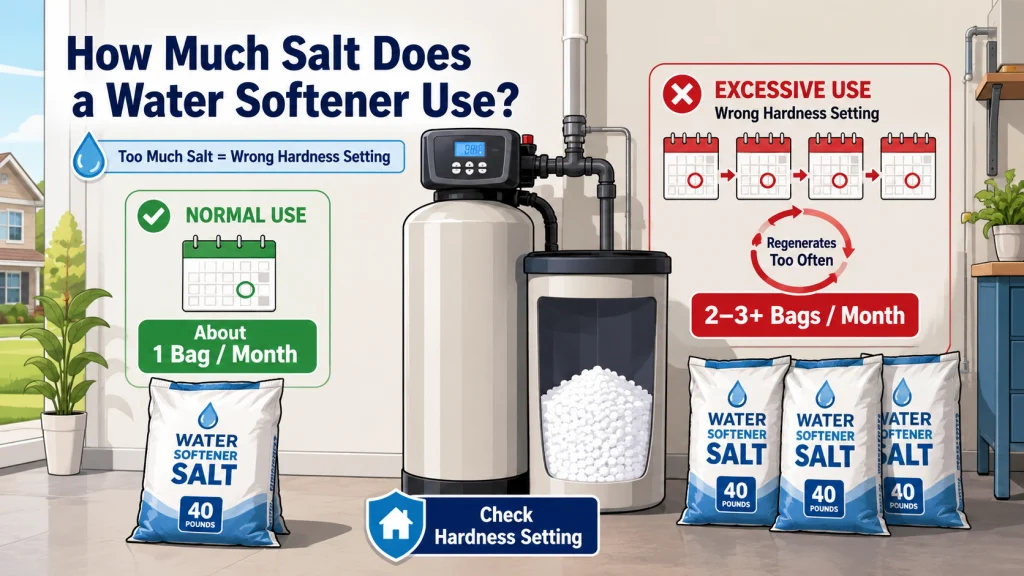
The benchmark I work from for a family of four with water in the 7 to 12 GPG range and a demand-initiated regeneration system is about one 40-pound bag of salt per month. That works out to roughly two to three regeneration cycles per week, using 6 to 10 pounds of salt per cycle. Some months run higher depending on household water use, but that one-bag figure is a reliable starting point for checking whether your system is behaving normally.
What complicates this is that the range varies considerably based on a few factors that interact with each other. Hardness level is the biggest variable, followed by the number of people in the house, and then whether the system uses a timer or a flow meter to trigger regeneration. I have seen well-maintained systems on 7 GPG city water use less than half a bag per month for two people. I have also seen systems on 20-plus GPG well water in a household of five go through two and a half bags a month without any malfunction. Both are normal for those conditions. Context is everything.
What is not normal is any single household at moderate hardness levels going through more than two bags per month. When the math stops making sense, something is worth looking at. The table below gives a rough consumption reference by household size and hardness level for a demand-initiated system.
| Household Size | Water Hardness | Estimated Monthly Salt (demand-initiated) |
|---|---|---|
| 1 to 2 people | 7 to 10 GPG | 15 to 25 lbs (about half a bag) |
| 1 to 2 people | 11 to 20 GPG | 25 to 40 lbs (about 1 bag) |
| 3 to 4 people | 7 to 10 GPG | 25 to 40 lbs (about 1 bag) |
| 3 to 4 people | 11 to 20 GPG | 40 to 60 lbs (1 to 1.5 bags) |
| 5 or more people | 7 to 10 GPG | 40 to 60 lbs (1 to 1.5 bags) |
| 5 or more people | 11 to 20 GPG | 60 to 100 lbs (1.5 to 2.5 bags) |
These numbers apply to demand-initiated systems. Timer-based systems typically run 30 to 50 percent higher because they regenerate on a fixed schedule regardless of actual water use. That distinction matters more than most people realize, and I will get into it in more detail below.
The Four Variables That Control Salt Consumption
Understanding what drives salt use matters because it tells you exactly where to look when consumption seems high. There are four variables that account for almost every case I have come across. They do not carry equal weight, and if you address them in order, you will find the problem faster.
Water Hardness Level
Harder water exhausts the resin bed faster, which triggers more frequent regeneration cycles, which uses more salt. A system handling 20 GPG water will regenerate roughly twice as often as one handling 10 GPG at the same household size. This is expected behavior, not a malfunction. The problem arises when the hardness setting programmed into the control head does not match your actual water test result.
What I run into often is systems that were set up using an estimate rather than a test result, or systems in homes where the original programming was never revisited after a move. If your hardness setting is 10 to 15 GPG higher than your actual water, your system will regenerate far more frequently than it needs to. That gap is pure salt waste, every cycle.
Timer-Based vs. Demand-Initiated Regeneration
Timer-based regeneration is the older approach. The system runs a regeneration cycle on a fixed schedule, regardless of whether the resin bed is actually depleted. On a day when the household uses very little water, a timer-based system may regenerate through a nearly full resin bed, burning 8 pounds of salt to accomplish almost nothing. This happens night after night, week after week, and the salt just keeps going.
Demand-initiated systems use a flow meter to track how many gallons have passed through since the last regeneration. When that total approaches the system’s rated capacity, it schedules a cycle. No unnecessary cycles, no wasted salt. From what I have seen over the years, switching from timer to metered control is one of the highest-impact changes a homeowner can make on an older system. The reduction in salt use can be 30 to 50 percent without changing anything else about the installation.
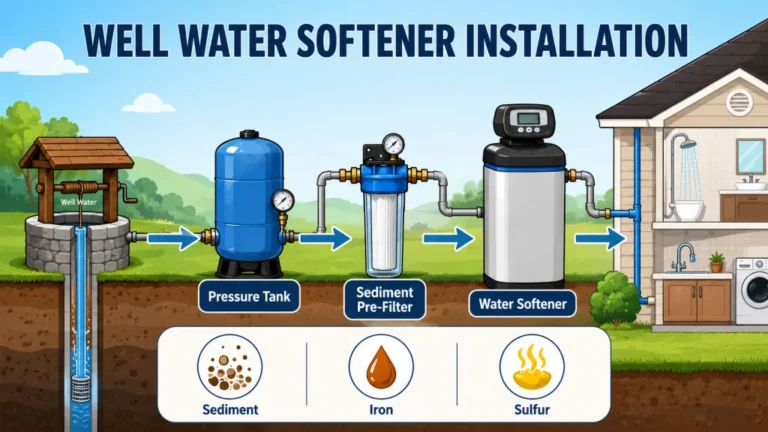
Deciding whether that upgrade makes sense is part of a broader set of maintenance decisions that affect how efficiently a softener operates over time. The practical guide on water softener installation and maintenance covers that full picture, including what is genuinely necessary versus what tends to get oversold at service appointments. If you are on a timer-based system and your monthly usage is running well above the table above, the timer is the first thing to evaluate, not the salt type or the equipment.
The Hardness Setting on the Control Head
This is the most consistently overlooked cause of high salt use, and the one that surprises people most because it does not look like a problem. The system is running. The water is soft. The salt just keeps disappearing faster than expected.
Field Note: I have seen situations where a homeowner had a hardness setting of 35 GPG on water that tested at 22 GPG. Their system was regenerating almost daily. They had been through two bags a month or more for the better part of a year and assumed that was just what their water demanded. When the setting was corrected, consumption dropped by more than half. The water was still soft. Nothing changed except how often the system was waking up to clean itself.
The right hardness setting is not always identical to your raw water test result, but it should not be dramatically higher either. Start with your actual GPG number from a recent test. If your water contains measurable iron, add 4 GPG for each part per million of iron. From there, a safety margin of 2 to 5 GPG is reasonable. The 50 percent buffer that some installation manuals suggest is overkill in most situations and will have your system working harder than the water requires.
Household Water Use
More people using more water depletes the resin bed faster, which means more regeneration cycles and more salt. A household that runs irrigation on softened lines, fills a pool during summer, or has unusually high bathing frequency will see elevated consumption during those periods. This is not a malfunction. One month of high salt use is not enough data to call something wrong. Track it over three or four months and look at the pattern before drawing any conclusions.

This whole-home water softener comes pre-loaded with 1.5 cubic feet of high capacity resin in a black USA-made mineral tank, paired with a USA brine tank featuring a safety float. The on-demand digital metered system ensures efficient water treatment, and the included 1-inch Noryl plastic bypass valve makes installation straightforward. Toll-free customer support is available whenever you need help.
Check On AmazonIf you click this link and buy, we earn a commission at no additional cost to you.
How to Check Whether You Are Using More Salt Than You Should
The fastest approach is to run a simple calculation and compare it to your actual consumption. This does not require any special tools, just a water test result and basic arithmetic.
- Multiply your household size by 75 gallons per day. That is a reasonable average daily water use per person across cooking, bathing, and laundry combined.
- Multiply that by your water hardness in GPG. The result is the number of grains your softener is removing from the water each day.
- Divide by your softener’s rated grain capacity, which is printed on the unit or in the manual. This gives you the number of days between regeneration cycles on a properly calibrated demand-initiated system.
- Multiply your expected cycles per month by the salt your system uses per cycle, typically 6 to 10 pounds for a standard residential unit in the 32,000 to 48,000 grain range.
- Compare that calculated figure to the bags you are actually going through each month.
Key point: Four quick red flags that salt use is probably too high: you are going through more than two 40-pound bags per month with three to four people and moderate hardness; the system regenerates daily even though household water use has not changed; your hardness setting is 10 or more GPG above a recent water test result; salt use stayed elevated for two full months after seasonal demand returned to normal. Any one of these warrants checking the control head before anything else.
If actual consumption is running significantly above what the math predicts, two causes cover most situations: the hardness setting is too high, or a timer-based system is regenerating more often than the actual water use warrants. Both are worth checking before assuming mechanical failure. In my experience, the fix is a settings adjustment far more often than it is a parts issue.
If you are also questioning whether the system is actually producing soft water on the other end of this, the article on how to test if your water softener is working walks through three simple home tests you can do before spending money on a technician visit.

This kit lets you test drinking water, pool water, or any water source in seconds using a simple dip-and-read method with an oversized color chart ranging from red to green, covering 0 to 25 GPG and 0 to 425 PPM. All 100 strips are protected by FreshSeal technology across a ready-to-use bottle and two sealed pouches for long-term accuracy. Each purchase also funds a full year of clean water for someone in the Central African Republic.
Check On AmazonIf you click this link and buy, we earn a commission at no additional cost to you.
Adjusting the Hardness Setting to Stop Wasting Salt
Most residential control heads have a straightforward programming menu and the hardness input is one of the first items listed. The exact button sequence varies by model, but the principle is consistent across nearly everything I have worked on: you enter a GPG number, and that number determines how quickly the system calculates that the resin bed is close to exhausted.
Get a current water test result before changing anything. Test strips from a hardware store work for a baseline. If you are on well water and suspect hardness has shifted, a more precise test from a local lab is worth the cost. Once you have your GPG number, set the control head to that figure, add your iron adjustment if applicable, and add the small safety buffer described above. That is the number the system should be running.
After making the change, give it at least four to six weeks before evaluating the outcome. Salt consumption will shift as the new regeneration frequency takes hold, and one month of data is not enough to confirm whether the adjustment worked. Track it, note it, and compare after a second full month. In most cases where the setting was significantly off, the reduction in salt use is obvious.
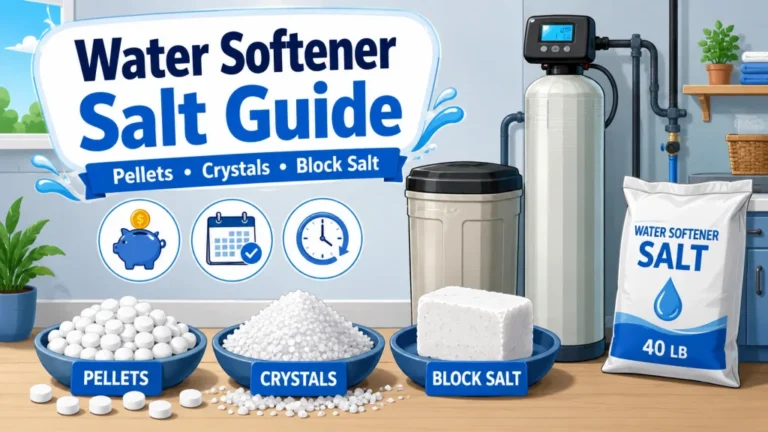
If you want to go deeper on what type of salt to put in the tank once you have the consumption dialed in, the full guide to water softener salt covers pellets versus crystals, iron fighter additives, and where to buy at the best price. Getting the type right and the quantity right are different questions, and both matter for long-term maintenance.
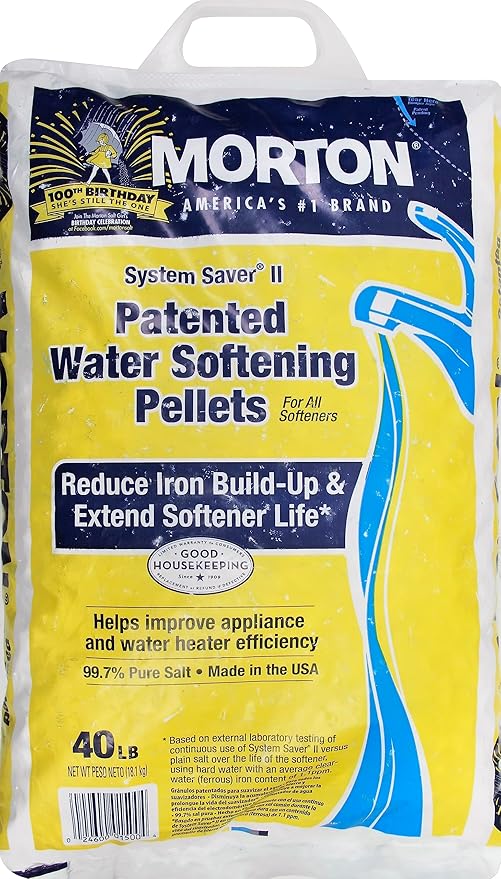
This 40-pound bag of USA-made System Saver pellets is designed to improve the taste of your water while helping extend the life of your appliances and water softener. Simple to use, just add the pellets directly to your softener's brine tank as needed.
Check On AmazonIf you click this link and buy, we earn a commission at no additional cost to you.
Final Thoughts: Salt Waste Is Usually a Settings Problem
Most homeowners who come to me convinced their softener is burning through too much salt have a calibration issue, not a mechanical one. The system works. The water is soft. But nobody ever went back and confirmed that the hardness setting on the control head matched the actual water test, or considered whether a fixed timer schedule still made sense for how the household uses water.
The math is not complicated. One bag per month is a reasonable expectation for most households at moderate hardness. If you are running well above that and cannot account for it with very hard water or a large household, check the control head settings before calling anyone. It takes five minutes, costs nothing, and in most cases it is the fix.

This professional-grade liquid cleanser removes iron, manganese, silt, metal particles, and other contaminants that salt leaves behind in your resin bed, valve parts, and beads. Regular use helps extend appliance life, reduce maintenance calls, and maintain consistent water quality across any water softener brand. It is NSF certified to NSF/ANSI/CAN Standard 60 for drinking water additives and is made in the USA, making it safe for families and pets. Apply 4 oz before each regeneration or use with the Pro Products Easy Feeder kit for daily low-dose treatment.
Check On AmazonIf you click this link and buy, we earn a commission at no additional cost to you.
FAQs
🧂 How much salt should a water softener use per month?
For a household of three to four people with water in the 7 to 12 GPG range, one 40-pound bag per month is typical for a demand-initiated system. Larger households or very hard water may reach one and a half to two and a half bags. Significantly more than that is worth investigating, starting with the control head hardness setting.
⚙️ Why is my water softener using so much salt?
The most common cause is a hardness setting that is too high relative to your actual water test result. The system regenerates more often than the water requires, which burns through salt without any additional benefit. Check the control head setting against a recent test and adjust if there is a significant gap between the two numbers.
🕐 Does a timer-based water softener use more salt than a metered one?
Yes, typically 30 to 50 percent more. Timer-based systems regenerate on a fixed schedule regardless of actual water use, which often means cleaning a resin bed that did not need cleaning yet. Metered systems regenerate only when the calculated capacity is close to exhausted, eliminating those unnecessary cycles.
💧 Is it normal for my water softener to regenerate every day?
Daily regeneration is unusual for most households. On a timer-based system set to regenerate nightly, it will always do so whether the resin needs it or not. On a demand-initiated system, daily regeneration at moderate hardness levels is a signal that the hardness setting may be too high or household water use is genuinely very high.
📊 How do I calculate how much salt my softener should use?
Multiply your household size by 75 gallons per day, then multiply by your water hardness in GPG. Divide by your system’s grain capacity to find the number of days between regeneration cycles. Multiply cycles per month by your system’s salt use per cycle, typically 6 to 10 pounds, to get an expected monthly figure.
🔧 How do I set the correct hardness level on my water softener?
Start with your actual water test result in GPG. Add 4 GPG for each part per million of iron if your water contains iron. Add a safety margin of 2 to 5 GPG. Set that total on the control head. Avoid the large percentage buffers that some manuals suggest, as they cause the system to regenerate more often than your water actually demands.
🪣 Does the type of salt affect how much I use?
Salt type has minimal effect on monthly consumption. Pellets, crystals, and blocks all deliver the same sodium for ion exchange. What changes consumption is regeneration frequency, which is controlled by the hardness setting and whether the system is timer-based or demand-initiated, not the physical form of the salt.